Showing posts with label momentum. Show all posts

Wednesday, June 14, 2017

Lagging Indicator Definition: Day Trading Terminology

Lagging Indicator Definition: Day Trading Terminology

This is an economic statistical indicator known to shift after macro economic conditions have shifted too. It also refers to a measurable indicator which has been found to change only after the economy itself has started to shift and follow a particular trend. According to financial experts, lagging indicators are technical factors known to trail the price action of an underlying security.
It is commonly used by traders with the purpose of generating transactional signals or even to confirm the strength of a given pattern. That is why a significant shift in the market occurs just before the indicator provides a signal.
A lagging indicator is beneficial when it comes to confirming long term trends but sadly, it does not predict them. Furthermore, it helps financial experts and business people to understand the economy and factors that shape it. That is why paying attention to lagging indicators gives one ideas on the direction of the economy allowing you to plan your finances or career beforehand.
Examples of lagging indicators
i. Unemployment rate
ii. Corporate profits
iii. Labor cost per unit
iv. Interest rates
v. Consumer price index

Unemployment Rate

Let’s face it; majority of nations around the world are faced with high unemployment rates. Graduates are leaving college and university for the job market only to find that no opportunities are available. Those that are available pay meager earnings which can be difficult to meet monthly needs like rent, food and student loan repayment.
One thing you need to note is that unemployment is used by economic experts to measure how many people are searching for work. That is why for an economy to be rated as healthy, the unemployment rate should be around 3% to 5%. This is not so in many nations.
The higher the unemployment rate, the less money people have to spend which in turn affects businesses like retail stores. The problem further affects housing markets, stocks and the GDP among others. While it’s a great indicator, unemployment rate can also be misleading. This is because it only reflects the unemployed who have sought jobs within the past four weeks.

Corporate Profits

It is a common practice for companies to announce their pre-tax and post-tax profits at the end of every financial year. This is so for publicly traded companies. The reason for doing so is to reveal to the shareholders how the company has performed.
Corporate profits are synonymous with the rise in GDP especially when they are strong. This helps to reflect an increase in sales finally encouraging job growth. Despite the good news above, corporate profits don’t reflect a healthy economy.
In 2008, nations around the world experienced economic decline as a result of recession. No one had predicted this outcome because several companies had experienced increased profits due to outsourcing and downsizing. The result was more jobs were taken out of the economy which shows that this economic indicator displayed the wrong outcome.

Labor Cost Per Unit

In the manufacturing sector, direct labor costs are determined by how quickly and efficiently factories are able to produce complete items. The costs do vary with every production run but to ensure efficiency, they have to remain within the same variance range. With the labor per cost unit, one can be able to identify why the actual costs are higher or lower.
As a lagging indicator, labor cost per unit has been found to increase when manufacturing companies produce less per employee. This has been attributed to slower orders. As a result, companies will begin to lay-off workers in order to survive. This will result in higher unemployment rates. Factories may also opt to produce more which may result in a surplus.

Interest rates

In the financial world, lending is a common phenomenon. It allows individuals and businesses to seek financial help which can be used to start a new business or expand the existing one. While financial help is readily offered, there is a catch…interest rates. This is the cost of borrowing money.
It is based on the federal funds rate and represents the rate at which funds are lent from one bank to another. The rate is normally determined by the Federal Open Market Committee.
What you need to know is that the rates do change as a result of economic and market events. If the federal funds rate rises, lenders and financial institutions will pay higher interest rates. This cost will definitely be passed down to the borrowers. As a result, borrowers will be discouraged to borrow resulting in the stagnation of the GDP growth.
Low interest rates can lead to inflation which distorts the economy and currency value. That is why interest rates are vital economic indicators.

Consumer Price Index

This is a factor that measures the weighted average of prices of consumer goods and services. Some of them include food, medical care, shelter, clothing, electronics and transportation among others. Financial experts calculate the index by considering the price changes of every item in the predetermined basket and averaging them. As a result, the changes are used to indicate the cost of living.
The consumer price index is reported on a monthly basis by the US Bureau of Labor Statistics. Two types are reported:
i. CPI-W
ii. CPI-U
CPI-W is used to determine consumer price index for urban wage earners and clerical workers. CPI-U is for urban consumers. A higher cost of living results in inflation which in turn erodes the value of the currency. This has been found to decrease the purchasing power, job growth and GDP. In case of deflation, the results could be an economic depression.

Final Thoughts

A healthy economy creates a suitable environment for businesses to thrive. Not only will new start-ups be opened but more people will be employed, borrowers will experience moderate interest rates and the cost of living will be favorable.
To determine the health of an economy, it’s wise to use lagging indicators. They include unemployment rate, corporate earnings, labor cost per unit, interest rates and consumer price index.

Wednesday, May 24, 2017

Let The Next Five Minutes Save Your Trading Career

trading career
 As a beginner trader, one the most important concepts to understand is all about psychology. The sooner we figure this out, the faster we’ll get the desired results. There are so many great books about this matter that I recommend you reading (my favorite one is “Trade Mindfully” by Gary Dayton) that go further in detail on describing how complex we’re built as human beings when it comes to mind balance.
In particular, dealing with losses is by far the biggest issue among traders (read more about it in my previous blog post here). From the newbie to the most veteran of all, every single one of us will experience getting stopped out of a trade, realizing a loss. Especially for day traders, from this point on the strongest desire is to immediately make it all back. The problem is now that the emotional composure can be in real trouble causing the ability to get good decisions about the next trade to be seriously compromised.
In fact, I personally believe that the capability to promptly bounce back and recover from a loss is one of the hardest to achieve when it’s much easier to jump into another trade and, next thing you know, to get into even deeper holes. If you’ve ever found yourself in this situation, here are my own four practical instructions to deal with it.

Add these four practical steps to the trading routine


Right after a losing trade (more importantly, in case this is the first trade of the day) I highly recommend to:

  1. Stop Trading for 5 minutes: take a deep breath and start the countdown timer. Until it doesn’t reach zero, do not take any more trades. Until then, focus on the next two steps.
  2. Write down your emotional state: always keep a pen and a sheet of paper nearby the trading station. Whether is anger, frustration or anything else it doesn’t really matter. Writing down how you feel is an effective way to start letting it go.
  3. Have a short walk: this will allow your mind and body to “physically” get rid of that sensation and, also, you can take advantage of this time to mentally post-process the trade. Did you respect the trading plan? Remembering that losses are part of the game always help.
  4. Wait until the next “A” quality setup: get back to the trading station, make sure that the countdown has finished and start hunting for the net “A” quality setup to present itself knowing that now, after only five minutes, you may have recovered the proper psychological state to start trading again.

Of course, this time-span is arbitrary and can be readjusted to fit your own personality. A great approach can be to lower this countdown time as experience grows. The main point remains that discipline, perseverance and patience will make a trader being successful in the long run.

“Use the losses and failures of the past as a reason for action, not inaction.” -Charles J. Givens

See you in chat-room!

Trade safe,

Roberto Barbaro

Thursday, May 18, 2017

The Ultimate Answer For Questions About Freedom

freedom

When I decided to radically change my life and to focus entirely on trading (read more about it in my previous article here), of course I did not know exactly what was lying ahead for me. But luckily, I decided to look at the mystery behind that state of uncertainty more as a stimulus than a hurdle that would have prevented me to move on. I’ve just had enough of the 9-6 office habit that I was willing to sacrifice the level of comfort I had gained and got prepared to start completely new.
During this phase of my life, I started digging deeply within myself with the only goal of working for something I was really passionate about. I quickly realized I wanted to learn how to trade mainly because I’m literally in love with the process of doing that (and, yes, I’ve done another article about this you can read here). With that said, I also love doing many other things, including a profound passion for traveling the world.
In fact, one of the greatest benefits about trading that has always been fascinating to me is the possibility to do it from potentially anywhere in the world. In my opinion, this is by any means, the ultimate definition of freedom. And I was in desperate need of that! But, that’s another story, because here I want to give you my best possible pieces of advice about trading “on the go”.

The top 4 tips for trading “on the go”


I always like to give my contribution to traders in the best possible way to truly help anybody that would find himself in the same situation. Personally, this is the first time I’m actually traveling and trading away from my main trading station. So here is what I’ve in store for you that I’m learning from trading and traveling:

  • Make sure your laptop has every tool and is set up with everything needed for your trading activity and test your traveling environment for at least one full trading day while still being at home;
  • Trade with lower size than usual, especially at your first experience. I’d suggest to not go over 50% of the normal sizing. You don’t want to get overexposed in a non-familiar environment;
  • You’ll never have the exact same setup or layout that you have in your main trading station at home and that’s ok. As traders, we always need to adapt to the surrounding circumstances, this is a great chance to prove yourself you can readjust to them. I’ve started trading with as little as one laptop and an iPad used as an external display and I can tell that’s enough to make money, as long as we’ve brought the skills to do so;
  • Prepare a checklist that contains everything you need when packing the next time. This will allow to have everything you need to perform the trading activity once you have a stable internet connection. And remember to keep updating it as your needs evolve.

“Man cannot discover new oceans unless he has the courage to lose sight of the shore.” – Andre Gide

See you in chat-room.

Trade safe,

Roberto Barbaro

Thursday, May 11, 2017


Grinding Out A Challenging Month As A Day Trader


Hey all, JohnL10 here!

Now that April is over, I can put some of my thoughts on paper about why I think it was a challenging month for both long and short biased small-cap traders.
From my perspective, there hasn’t been much follow-through on positive corporate news from the companies that we focus on, and it seems like we’re on the tail end of a lot of hype from earlier this year. Contrary to Q1 of 2017, where I have already made more than a 6-figure salary in 3 months, Q2 is starting to be much more challenging.

Here’s the run down:

Many of the stocks that we’ve traded in Q1 have raised a lot of capital, even back during Q3-Q4 of 2016. During that time, stock that was sold to private investors gets locked up and is restricted from trading. Most lock ups are anywhere from 3 to 6 to 12 months long.
I feel like for the entire month of April, maybe those shares are now unlocked, and those investors are selling at any price, thus what is making stocks that gap up on positive news, make new lows and go red on the day, sometimes often making a new low right before market close. Something like that, isn’t short-biased traders pounding a stock down, it’s financers selling their unlocked shares all day long, taking easy profit off the table.
That’s not anything new if you have experience in the capital markets, or know anything about how these companies are financed. Debt, or worse, toxic debt is sometimes the only way for these companies to raise money and keep the lights on. Now of course, short sellers take advantage of the opportunity and take a small piece out for themselves, but from what I have been seeing, it hasn’t been easy for shorts either.
The market is crowded and every newbie trader wants to short, making many trades difficult. This also is making borrowing very hard for the more experienced traders. They are left with only the hardest and most expensive borrows, which makes their trades quite limited. It got so bad I have even seen short biased traders tell new people to go long! They want people off their playground.
It’s quite simple, if traders see stocks keep going up, like the shipping mania for example, everyone wants to go long. Then a trend-shift, traders see stocks giving back almost all their gains or more, they want to go short. For me, I stick to what I am good at. I go long, and the only difference in this kind of market is how long I go long for.
The reality is there’s a finite amount of borrows out there, and if enough people want to go short, there won’t be any supply. So what happens then?
The market usually corrects itself and punishes naïve traders via a short squeeze.
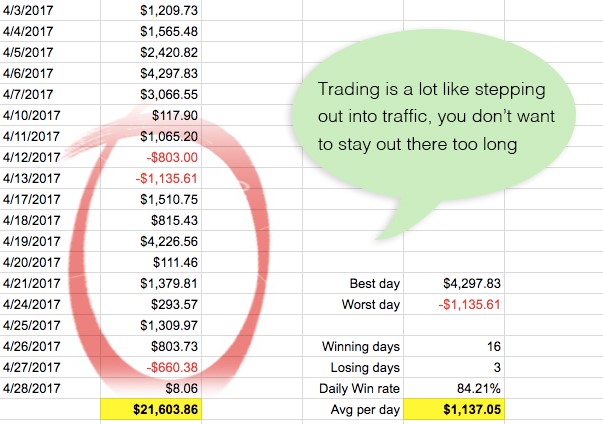
The market gives and it takes, but when it takes, you must hold on for dear life. In the screen shot below of my trading P&L for April, I make an analogy about walking into traffic. You don’t want to stay out there for too long or you will get killed.

Day Trader

That’s how April was as a long-biased trader. If you overstayed your welcome in a trade, you were killed. If you stepped out at the wrong time, you were killed. If you stepped out in front of the wrong trade even if you timed it right, you were killed, if you tried to make any bias about corporate news, you were killed. There was only 1 way to live, and if you figured it out soon enough, you might have done well. If you didn’t, you learned something about yourself and will become a better trader.
I am not sitting here all high and mighty, trading is a very difficult. Emotions are not easy to overcome, as they keep changing and becoming more complex as you evolve as a trader. The emotions you had when you started to trade are long gone and now suddenly, you have much more different emotions. It’s a constant struggle with ones self.
The reality is from 4/12 to 4/28 I was almost red every other day. Being up 4-figures, and then a small 3-figure profit. Then being up 4-figures again, and then up only 3-figures. Those 3 figure days I barely got out alive. I was probably even red on most of those days and somehow came back to green.
So what’s the end result? I still grossed $21K on the month, averaging about $1.1K per day for the month of April. A $21K month is $250k+ a year in just capital gains. I am cool with that; especially considering that I have other businesses that provide income! The most important thing I had to realize was, I really needed to not have a big red day, as I knew, if we never saw a good trade for the rest of the month, it would be hard to recover.
The strategy I trade is very similar to what Ross trades day to day and what he teaches in Warrior Pro course. Although Ross himself had somewhat of a difficult month, he also has additional pressure of being the head moderator who voluntarily reports his entire trade history daily. That’s a lot of stress that I don’t have. I don’t know any traders that do daily video recaps, showing their P&L like he does throughout the good and the bad, only to have people judge you. So you have to give a certain amount of respect for that, it’s not as easy as it seems to lead, trade and teach, all at the same time.

So that about wraps up what I wanted to say. Many traders can trade the same strategy and have wildly different results, and I think April is a good example of that.

Keep it up, and see you in chat.

Thursday, April 27, 2017

4 Technical Indicators That Every Day Trader Should Know


Indicators

Trading is one of the most complex, challenging and intimidating professions in the world. On the one hand, you have so many sources of information available that it is impossible to absorb it all.
On the other hand, even with all this information available to you, every single trade you make will still contain an element of uncertainty.
Fortunately there are a few key sources of information that are always relevant for any trade that you make. Here are 4 top technical indicators that will help you to make smarter trades every single time.

Relative Volume

Relative volume compares the current trading volume to the average volume for the same time of day. It is displayed as a ratio. For example, if a stock is currently trading at 5 times its average volume for that time of day, then the relative volume would be 5.
Relative volume is an indicator of how much action a stock has seen so far that day. A score of less than 1 means that the stock is moving slowly compared to most other days, which indicates that it is not a great candidate for trading on that day.
A score of 2 or more indicates a lot of interest, and means that there is a good chance for a significant price move which is what day trader want. You can also use relative volume to help you determine the size of your position.
The higher the relative volume, the more “in-play” a stock is and the greater the chance of a significant move.

Time & Sales

Time and sales is an indicator that displays all the trades that have been executed, along with the time and size of each trade. A green print indicates a trade executing on the ask price, and a red print indicates a trade executing at the bid price. White prints are for trades that cleared between the bid and ask.
Time and sales shows the number of shares being executed at which price, which offers insight into the current aggressiveness of traders. This indicator is excellent for helping you to choose entry and exit points for each trade and identifying likely pivots in price.
You will often notice a swift acceleration of trading volumes as you approach likely pivot points, which means that there is a good chance that prices will quickly reverse.
It takes a bit of practice to get a feel for using the time and sales indicator, but it is an essential component of any informed trade.

Volume Weighted Average Price

Volume weighted average price, or VWAP, is a technical indicator calculated by finding the total value of all shares bought in a day (each share traded multiplied by the price of the trade), and then dividing that number by the total number of shares traded that day. The result is an average price based on the weight of volumes traded at different prices.
This indicator is ideal for identifying good prices to enter and exit a position. The opening and closing prices of a stock may be a poor indicator of the true demand and supply for that security.
VWAP helps to bring additional context to a stock’s price by showing the average price where significant trades are actually being made.

Level 2

Level 1 indicators is the current bid/ask quote for a stock. Going one step further, Level 2 displays price quotes at each price level and the name of the market maker that is holding the order.
It is crucial to remember that every disappearing order does not indicate that it was necessarily filled. Market makers can pull their orders at any time, and Level 2 just displays open orders.
The information that Level 2 provides is very important for every trade. This information allows you to identify points of significant price support that the simple bid/ask spread provides no indication of.
In essence, Level 2 allows a preview of the kind of trade volume that you can expect at different prices as the bid/ask spread moves into that price region.

Thursday, March 30, 2017

Marriage And Merging Money

Marriage And Merging Money

Money is often an issue that tends to cause the most friction between a newlywed couple. In a world where the majority of people are concerned with their own personal well being, it is easy to forget that marriage is a mutual arrangement, not a solitary effort. Trust is a vital component in establishing a strong commitment in this shared life with your new spouse. A couple’s financial situation can be the source from which a newly forged partnership flourishes or the one thing that can sabotage a relationship.

As you begin your journey and build a future together, carefully consider the following do’s and don’t’s of money management in marriage.

The Do’s

Set Boundaries
Establish an understanding that you and your spouse have made a commitment to each other and that the majority of monies should be shared. Create a household budget and manage the mutually held funds accordingly. All should be considered “ours, not mine.”

Create Bank Accounts
Create three separate bank accounts. One individual account for each spouse and a joint account where an agreed upon amount will be deposited monthly based on a percentage of earnings. The joint account will function as the expense account for the household from which all monthly bills are satisfied.

Pay Off Debt
There are very few investment decisions a couple can make that have a greater return than eliminating debt. Paying off credit cards or loans with exorbitant interest rates of say 15-20% or more is the economic equivalent of an investment with the same return. Incorporate debt payments into the monthly budget and always strive to pay more than the minimum payment. The balance of remaining money should be used for an emergency fund; even $20 a week compounds quickly and can help in the event of an unexpected surprise.

The Do Not’s


Overlook Retirement
Retirement years appear to be far off and are oftentimes overlooked in the financial planning process as you have more pressing issues to deal with after recently being married. However, it is imperative that you set aside a predefined amount each month for retirement, regardless of what you earn. Utilize your employer’s retirement savings plans especially if they offer a matching contribution as this is free money at no charge to you while providing significant tax benefits. According to the New York Times, odds are strongly against you in saving enough money to support your retirement.

Lie
According to Forbes, 31% of Americans polled attest to having lied to their spouse about money. Newlyweds can circumvent the frustration and stress that comes along with deception by formulating a set of rules and talking openly about finances. Create a budgeting plan and stick to it.

Take On Additional Debt
Living within your means is easier said than done, but it is important to not overspend and ensure your financial future. Budgeting to live slightly below your means is ideal, as you then have the ability to save something and get one step closer to financial freedom. Debt acquired prior to a marriage and how it is handled can become quite complicated. Nothing can substitute the time spent consulting with a professional such as an attorney or accountant to determine how this type of debt is managed in accordance with state laws and other regulations.

Final Thoughts

This list is by no means exhaustive but discussing these “do’s and don’t’s” is an enormous stride in the right direction. As these discussions commence, additional concerns are sure to arise and keeping an open and honest discourse about money will pay off in numerous ways.

Tuesday, December 6, 2016

Pursuing a Gap-and-Go Trading Strategy at the Opening Bell


Drawing on the knowledge of experienced Wall Street swing and day traders, Warrior Trading enables investors to consistently take advantage of market fluctuations. The active professionals at Warrior Trading employ diverse strategies, including momentum, reversal, and gap and go.

A disciplined approach to shorting stocks, gap trading involves actively seeking out those stocks displaying a significant price gap from the previous close. Warrior’s gap-and-go strategy employs Trade-Ideas scanners in identifying gappers. This is followed by a look into the catalyst for the gap. Pre-market highs are marked, with an emphasis on finding stocks that hold the upper end of the gap and are not being sold off prior to the opening bell. 

An order is prepared for stocks that meet specific criterion, aligned to pre-market highs. During the first minute, opening-range breakout (or candle) gappers are purchased, with stops placed on the low of the candle. 

Reasons for this strategy being successful, with an opening bell squeeze occurring despite previous gapping, has to do with the event catalyst that has often just occurred. Retail traders are anxious to jump onto a stock that is already trending upward, secure in the knowledge that further gains can often be realized in the first half hour of trading.